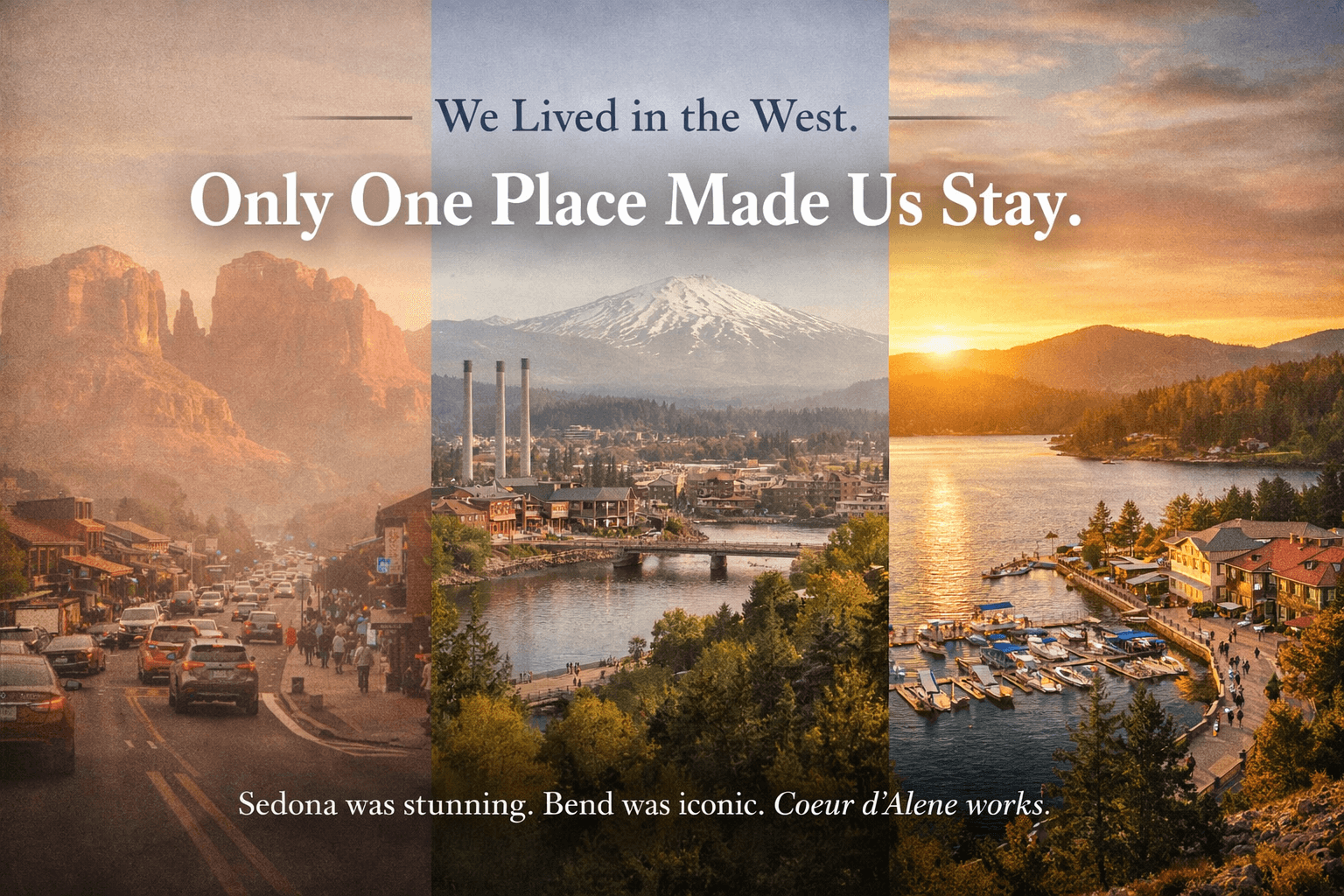
We need to get something out of the way upfront: this is not a tourism article. This is not a ranked list of "best places to live in the West." This is what actually happens when two people spend close to twenty years living in, traveling through, and honestly evaluating the places that everyone's moving to, and the places everyone's leaving.
We've had a mailing address in Bend, Oregon. In Issaquah, Washington. In Austin, Texas. In Mesa, Arizona. We've spent serious time — not weekend trips, but weeks and months — in Prescott, Sedona, Show Low and Pinetop, and Greer, Arizona. We've driven Highway 1 from Astoria to Big Sur. We've mountain biked in most of these places. We've grocery shopped, sat in traffic, checked internet speeds, looked at real estate listings, and had the "could we actually live here?" conversation in every single one.
After all of that, there are only two places we ever compared to Bend, Oregon when it comes to raw natural beauty: Sedona, Arizona, and Coeur d'Alene, Idaho.
And only one of them is actually livable.
Bend, Oregon: The One That Outgrew Itself
Let's start with Bend because that's where the measuring stick is for a lot of people reading this.
We lived in Bend for 15 years. Not as tourists. Not as remote workers who showed up during COVID and bought a house on Zillow. We were there when it was still a mill town that happened to have a ski resort. We watched it become one of the most sought-after outdoor lifestyle destinations in the country. And we watched what that did to it.
Bend's natural setting is genuinely world-class. The Cascades, the Deschutes River, Mt. Bachelor, Smith Rock, the high desert — it's stunning and diverse in a way that's hard to find anywhere else. The brewery scene, the trail systems, the culture of outdoor recreation baked into daily life — all of it was (and still is) real. We spent years riding the Wanoga trail system and lapping Mt. Bachelor's bike park. Those trails are legitimately some of the best in the Pacific Northwest.
But Bend didn't just get popular. It got overwhelmed. The population has tripled from about 35,000 to over 100,000. Housing costs have exploded — the area median income is now around $123,500 for a household of four, and even at that level, over half the city's neighborhoods are classified as unaffordable. A book was literally published in 2025 about Bend's housing crisis. The city needs to build over 15,700 homes in the next eight years just to address the shortfall.
Traffic on the parkways and corridors that used to flow freely now backs up routinely. Trailheads that were empty on weekdays a decade ago require 7 AM arrivals on a Saturday. The restaurants that once felt like hidden gems now have 45-minute waits. Bend didn't stop being beautiful — it stopped being livable for the people who made it what it was.
We still love Bend. But we left because the place we moved to in 2008 is not the same place that exists today. And that's not just our opinion — it's reflected in the data showing lower-income residents leaving while wealthier transplants drive the median up.
Sedona, Arizona: Gorgeous, But Built As a Tourist Trap
Sedona is the one place that genuinely stopped us in our tracks visually. The red rock formations are unlike anything else in the American West. Cathedral Rock at sunset, the view from Airport Mesa, the drive through Oak Creek Canyon — it's otherworldly. We understand why people fall in love with it on a three-day visit.
And that's the problem. Sedona is designed for a three-day visit.
A town of 10,000 permanent residents absorbs somewhere between 2.8 and 5 million visitors per year, depending on whose numbers you trust. Tourism tripled in the last decade. The entire economy, and the entire infrastructure, is built around hospitality. The two main highways, SR 89A and SR 179, form a Y intersection that becomes a parking lot on weekends, holidays, and frankly most afternoons from March through October. Cars back up from Uptown Sedona through Oak Creek Canyon. Trailhead parking overflows into residential neighborhoods. The town has spent years studying the problem and the honest answer from officials is: there's no fix. The roads are constrained by geography, most are owned by ADOT rather than the city, and there's no room to build alternatives.
As a visitor, you can work around this. As a resident, it's your life.
And here's the other thing nobody tells you about Sedona: the town itself — the restaurants, the shopping, the "scene" — feels like it was purpose-built for tourists. Pink Jeep tour offices, crystal shops, overpriced Southwestern galleries, and chain-adjacent dining dressed up in red rock aesthetics. It doesn't feel like a real town where real people live. It feels like a theme park with an incredible backdrop.
We'd go back to Sedona in a heartbeat for a long weekend. We'd never sign a lease there.
Prescott, Arizona: Isolated and Overhyped
Prescott gets talked up a lot in the "affordable mountain town" conversation, and on paper we understand why. The Courthouse Square is charming. Whiskey Row has character. The weather is milder than Phoenix. It's got a small-town feel that a lot of people are looking for.
But actually spending time there? It just doesn't deliver.
Prescott is isolated. The nearest major airport is Phoenix Sky Harbor, roughly 100 to 110 miles south, a 2 to 2.5 hour drive depending on traffic on I-17. Prescott's own regional airport has extremely limited commercial service through the Essential Air Service program, which has been repeatedly targeted for federal budget cuts. If you need to fly anywhere regularly, Prescott is a logistics headache.
The summer monsoon season brings intense thunderstorms that are dramatic to watch but genuinely disruptive to daily life. Winters are colder than most people expect for Arizona — it sits at 5,400 feet and gets real winter weather. So you're not getting the Arizona sunshine lifestyle that the brochures suggest, and you're not getting the ski-town winter culture that makes cold weather worth it.
And frankly, the town itself just isn't that interesting beyond the square. The dining is limited. The cultural scene is thin. If you're coming from a place like Bend or Austin and expecting a vibrant, outdoorsy, slightly hip small city, Prescott will feel like a letdown. It's fine. It's just not the place worth uprooting your life for.
Show Low and Pinetop, Arizona: Beautiful, But Not a Town
The White Mountains of Arizona are genuinely beautiful. The ponderosa forests, the meadows, the local skiing at Sunrise Park Resort, the mountain biking — the raw ingredients are there. Show Low and Pinetop sit at around 6,400 feet and offer a legitimate four-season escape from the Phoenix heat. We rode the lift-assisted bike park at Sunrise — it's Arizona's only lift-served downhill mountain biking, and the trails through those forests at nearly 11,000 feet are fun. The park has promise and they've been investing in trail building.
But here's the reality: there's no real town. It's a highway corridor with businesses along it. There's no downtown core, no walkable district, no gathering places that create a sense of community. The "scene" that makes a place feel alive — the coffee shops, the breweries, the Friday night energy — doesn't exist here.
Sunrise Park Resort sits on the Fort Apache Indian Reservation, which means the surrounding recreation infrastructure is limited compared to what you'd find on public land. The resort itself has promise, but the broader amenities and services that make a mountain town work for year-round living just aren't developed.
Could it become something? Maybe. But right now, it's a place to visit for a weekend of mountain biking or skiing, not a place to build a life.
The California Coast: Beautiful Drive, Not a Life Decision
We drove Highway 1 from Astoria, Oregon down to Big Sur in our Sportsmobile. It is, without question, one of the most spectacular drives in the world. The Oregon coast, the redwoods, the dramatic cliffs of Big Sur — if you haven't done it, add it to the list.
But here's what nobody talks about in the "move to the California coast" fantasy: the coastal towns are either unaffordably expensive, depressingly gray for most of the year, or both. The Northern California and Oregon coast gets hammered with rain, wind, and fog from October through May. The charming little towns — Mendocino, Cannon Beach, Yachats — are vacation destinations, not functional communities with diverse economies and real infrastructure.
And the Big Sur stretch? There's literally nowhere to live. It's one of the most beautiful places on Earth and it's essentially a scenic highway with a few resorts. It's a road trip, not a relocation strategy.
Issaquah, Austin, and Mesa: The Other Side of the Equation
We lived in Issaquah, in the foothills of the Cascades east of Seattle. Beautiful access to Tiger Mountain, great proximity to alpine recreation, and the Seattle metro's economic engine. But the cost, the traffic, the gray — 226 cloudy days per year — and the density of suburban sprawl eventually push you to ask: am I actually using all this outdoor access, or am I sitting in traffic on I-90 dreaming about it?
Austin was a different kind of letdown. The music scene, the food, the energy — all real. But Austin's outdoor recreation is flat, hot, and limited compared to mountain towns. Lady Bird Lake and Barton Springs are nice. They're not a lifestyle. And the explosive growth and traffic that Austin has experienced make Bend's problems look quaint.
Mesa gave us sunshine and access to the Superstition Mountains, and the mountain biking was better than most people realize — we were riding the Hawes Trail System four days a week, and that network of desert singletrack is legitimately fun. But the sprawl of the Phoenix metro area, the soul-crushing summer heat, and the lack of any real walkable community made it feel temporary from day one. It was functional, not inspiring.
Coeur d'Alene: The Only Place That Matched Bend — And Then Beat It on Livability
After all of it — every mailing address, every extended stay, every mountain bike ride in a new town — only one place matched what Bend was when we first fell in love with it.
Coeur d'Alene sits on a 30-mile glacial lake surrounded by forested mountains and framed by the Idaho Panhandle National Forests — 2.5 million acres of public land. The natural beauty isn't subtle. It's not a "nice setting." It's the kind of landscape that makes you pull over and just look at it. We'd only had that reaction in two places before: Bend and Sedona. And CDA has something neither of those places has — it works as an actual, daily, year-round place to live.
Here's what CDA gets right that the other places miss:
The beauty-to-livability ratio. Sedona matches CDA visually but fails on livability. Bend matches CDA on lifestyle culture but has been crushed by growth. CDA has world-class natural beauty AND a functional, affordable, uncrowded daily life. That combination is what we couldn't find anywhere else.
The scene exists but hasn't been ruined. Downtown CDA along Sherman Avenue has real restaurants, real breweries, locally owned shops, and a waterfront that belongs to the community, not to tourists. The floating boardwalk, McEuen Park, Tubbs Hill — these are places locals actually use every day, not attractions designed to extract money from visitors. There's a Friday-night energy here that reminds us of what Bend felt like in 2010.
The outdoor access is better than Bend's — and almost nobody knows it. The Centennial Trail, the national forest trail systems, the lake, the rivers, the proximity to Schweitzer for skiing, Silver Mountain, Lookout Pass — and none of it is crowded. Our normal riding rotation is Canfield Mountain right here in CDA and Beacon Hill across the state line in Spokane — both are legitimate trail networks that would be headline attractions in most mountain towns. And in the summer, we're doing laps at Silver Mountain's bike park, which is the best lift-served mountain biking we've ridden outside of Whistler. That's not hyperbole — the trail quality, the vertical, and the variety at Silver genuinely compete with the big-name parks. Try getting that kind of access with a 75-minute drive from Bend.
It's connected, not isolated. Spokane International Airport is 35 minutes away with 23 nonstop destinations. Credit to Bend — they've expanded Redmond Municipal Airport significantly over the years and now have around 10 nonstop routes to western hubs like Seattle, Denver, Phoenix, and LA. But Spokane's reach is still broader, especially for business travel to the East Coast and Midwest, and it's a 35-minute drive versus Redmond's 20 minutes from Bend. The real comparison is Prescott's two-hour haul to Phoenix Sky Harbor for anything beyond a handful of subsidized routes. CDA gives you legitimate air travel access without sacrificing the small-town feel. This is the factor that kills most mountain towns for anyone who needs to travel for work.
The cost equation still makes sense. Bend's area median income is over $123,000 and even that doesn't buy you into half the neighborhoods. CDA's housing market is real but not yet broken by the kind of speculative growth that consumed Bend. You can buy a home with a fenced yard and mountain views for what a condo in Bend's Old Mill District costs.
The weather is honest. We wrote an entire post about what winter actually looks like here. Yes, it's cold. Yes, there's a gray stretch from November to February. But unlike Issaquah's 226 gray days, CDA gets real seasons — genuine summer heat, legitimate fall color, snow that makes the mountains accessible rather than oppressive, and a spring that feels earned. And unlike Prescott's surprise thunderstorms or Mesa's five months of uninhabitable heat, CDA's weather patterns are predictable and manageable.
The Bottom Line
We've had this conversation with dozens of people who are in the research phase of a relocation. They always ask us to compare CDA to Bend, or to Sedona, or to Prescott, or to whatever town their brother-in-law moved to. And our answer is always the same.
Every one of those places has something good going for it. Bend's outdoor culture is real. Sedona's beauty is real. Prescott's charm is real. But every one of them also has a fatal flaw that you don't discover until you actually live there — the cost, the traffic, the isolation, the crowds, the lack of a real town underneath the tourist veneer.
CDA is the first place we've lived where the fatal flaw hasn't shown up. Not after six months. Not after a year. Not after seeing it in every season. The beauty holds up. The scene holds up. The livability holds up. And unlike every other "cool" mountain town in the West, it hasn't yet been overrun by the very people it attracts.
That window won't stay open forever. But right now? This is the place.
Curious about the numbers behind the move? Read our Cost of Living: CDA vs. Bend vs. Prescott comparison. Want to understand the tax advantages? Check out The State Line Strategy: Idaho vs. Washington. And if you're a remote worker wondering about the infrastructure, we wrote the definitive guide to Remote Work From the INW.
Got questions about making the move yourself? Get in touch. We've done this — and we're happy to share what we've learned.